Due to technical difficulties, this Pheno Forecast is not currently being updated for 2026. Please check back next year for updated map status.
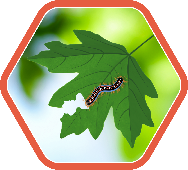
Bagworm caterpillars defoliate over 50 families of evergreen and deciduous trees and shrubs, primarily arborvitae, juniper, pine, and spruce. Stripping of leaves and needles is most noticeable in uppermost parts of plants. If left untreated, these pests are capable of extensive defoliation which can cause branch dieback or death.
WHAT ARE PHENO FORECASTS?
Pheno Forecast maps predict key life cycle stages in invasive and pest species, to improve management efficacy. For insect pest species, Pheno Forecasts are based on published growing degree day (GDD) thresholds for key points in species life cycles. These key points typically represent life cycle stages when management actions are most effective. These maps are updated daily and available 6 days in the future.
Help us improve these maps! Our Pheno Forecast map products are still in development, and we seek input on their performance in your area. Give your feedback at the bottom of the page.
SPECIES BACKGROUND
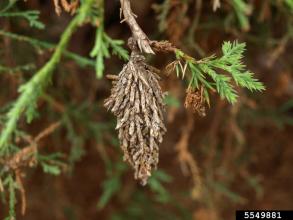
Bagworm (Thyridopteryx ephemeraeformis), known as common bagworm, evergreen bagworm, eastern bagworm, North American bagworm, or common basket worm, is a native moth pest in the U.S. Bagworms overwinter as eggs inside the female’s abdomen inside the bag she constructed. Eggs hatch and caterpillars crawl out of the bag, forming a shelter over their bodies with silk and plant material from the trees on which they feed.
CATERPILLAR FORECAST
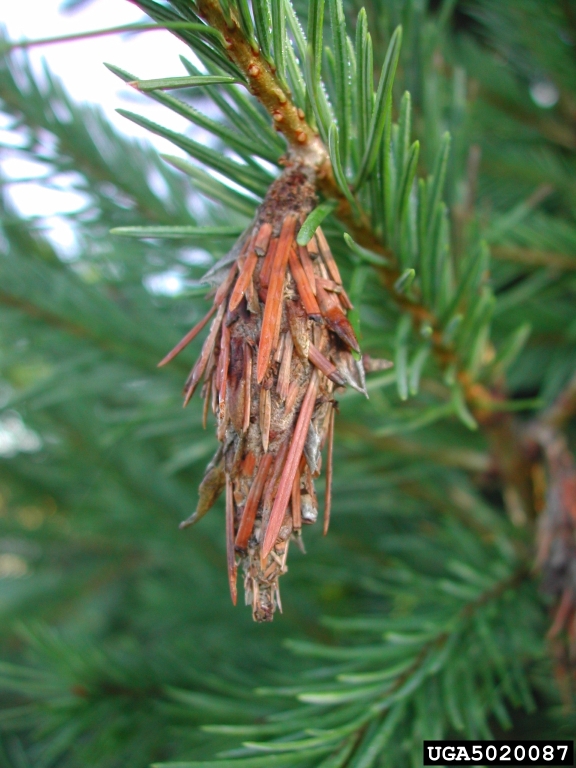
We forecast caterpillar emergence based on growing degree days. Bagworm outbreaks can be reduced by low winter temperatures and a complex of several parasites. Bagworms may be manually controlled by picking and destroying the bags. On evergreen trees, the cases are easiest to detect in fall after the cases have turned brown. When bagworms are too numerous to handpick, an insecticide application may be effective. Ideally, treatments are undertaken after caterpillars emerge and when caterpillars are small, as treatments are not as effective against larger caterpillars. For specific information on preferred treatment options in your region, we recommend contacting your local extension agent. Additional treatment resources are available through Penn State Department of Entomology and Ohio State University Extension.
| Phenophase | GDD threshold | Base temp | Start date | GDD method | Model origin | Source |
|---|---|---|---|---|---|---|
| Caterpillar emergence | 600-900oF | 50oF | March 1 | Simple average | NY | Cornell University Cooperative Extension |
More information on map development and re-use policy.